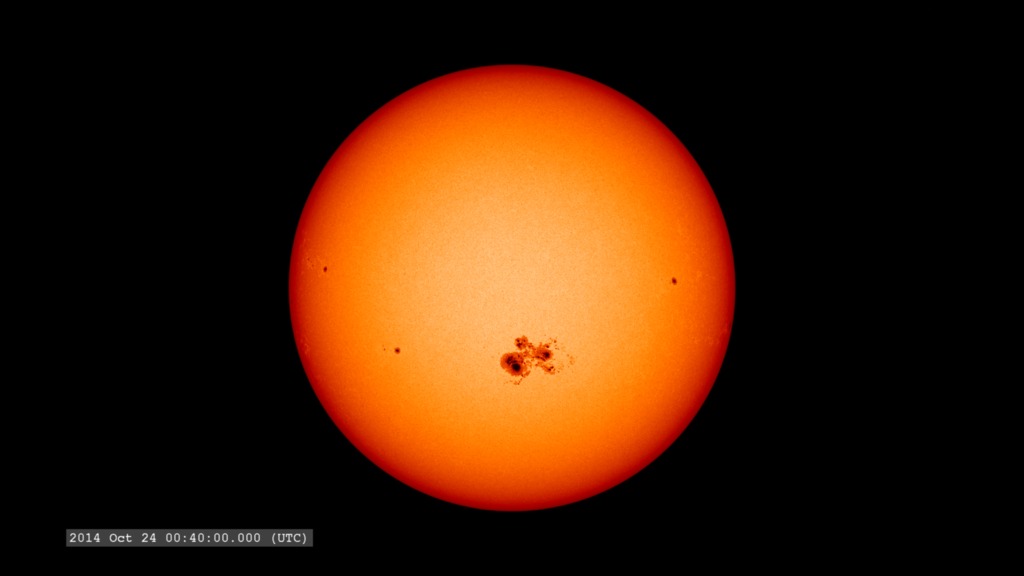
Dark spots on a bright surface
Sunspots are regions of the photosphere, the Sun’s visible surface, that look darker because they are relatively cooler than their surroundings. They are associated with concentrated magnetic fields that inhibit heat transport towards the surface. “Cooler” does not mean cold by everyday terrestrial standards: the comparison is between regions of the same star. A sunspot is neither a hole in the Sun nor a missing piece of it. It is a magnetic and thermal structure observed in the photosphere, distinct from phenomena in the corona.
Umbra, penumbra and groups
The darkest part is called the umbra; a lighter penumbra with a filamentary structure may develop around it. Sunspots can occur in groups, evolve and display different magnetic configurations. NOAA analyses their size and complexity to monitor solar activity. Their number varies over an approximately eleven-year cycle, with maximum and minimum phases. The count is an activity indicator, rather than an automatic announcement of a hazardous event at Earth. Describing a particular region requires observations and a specific time reference for the measurements being discussed.
Flares and ejections are different phenomena
A solar flare is an intense release of electromagnetic energy associated with magnetic-field reorganisation. A coronal mass ejection, or CME, instead carries plasma and magnetic field outwards from the corona. The phenomena can be connected, but are not identical. A large sunspot alone does not establish whether an Earth-directed CME will occur. The October 2014 group AR 12192, documented in NASA’s record for our image, produced numerous flares but only a small CME, providing a useful example of why these events should not automatically be equated.
Geomagnetic storms concern Earth
A geomagnetic storm is a disturbance of Earth’s magnetosphere associated with energy transfer from the solar wind. What matters includes the plasma and magnetic-field conditions reaching Earth, rather than simply a sunspot’s appearance in a photograph. Effects can involve the ionosphere, communications and satellite navigation. Calling these “geothermal storms inside a sunspot” would confuse different physical phenomena. Professional analysis follows solar observations and measurements in near-Earth space to assess the interaction. An archive image cannot establish a current alert or the conditions being experienced at Earth today.
Where the Sun’s energy comes from
The energy powering the Sun is generated by hydrogen fusion in its core. Sunspots instead concern magnetic and thermal conditions in the photosphere. Studying their development does not mean observing a process capable of suddenly switching off the star. Solar evolution and variations in magnetic activity both belong to solar physics, but involve different mechanisms and timescales. Keeping those levels separate explains why a phenomenon can matter for space weather without turning it into an unsupported prediction about the Sun’s imminent end or a claim about its core energy production.
What the cover image shows
The cover derives from real observations by the HMI instrument aboard the Solar Dynamics Observatory and shows AR 12192 on 24 October 2014. Orange is an assigned display colour for photospheric intensity; this is not a view of today’s conditions. NASA’s resource distinguishes this sequence from AIA’s ultraviolet observations. Knowing the instrument, measured quantity and date accompanying an image helps us recognise what we are observing, compare phenomena appropriately and avoid interpreting an eye-catching image as a forecast of events that have not been established by measurements.
Sources and further reading (7)
- science.nasa.gov · sunspots
- NOAA · Sunspots and the solar cycle
- spaceplace.nasa.gov · en
- NOAA · Coronal mass ejections
- NOAA · Geomagnetic storms
- NASA · Sun Facts
- svs.gsfc.nasa.gov · 4246
Sources checked: 2026-11-19.