An ocean that sends out samples
Enceladus looks like a small ball of ice, yet the water vapour and particles escaping from its south pole reveal a very different world. This moon of Saturn has a salty ocean beneath its crust, and some of that material reaches space through surface fractures. The Cassini spacecraft could fly through the plume and analyse its constituents without drilling through the ice. That makes Enceladus particularly interesting for astrobiology, the study of life in the Universe and the conditions that might make it possible. The ingredients identified there, however, do not amount to a discovery of living organisms.
The fractures known as tiger stripes
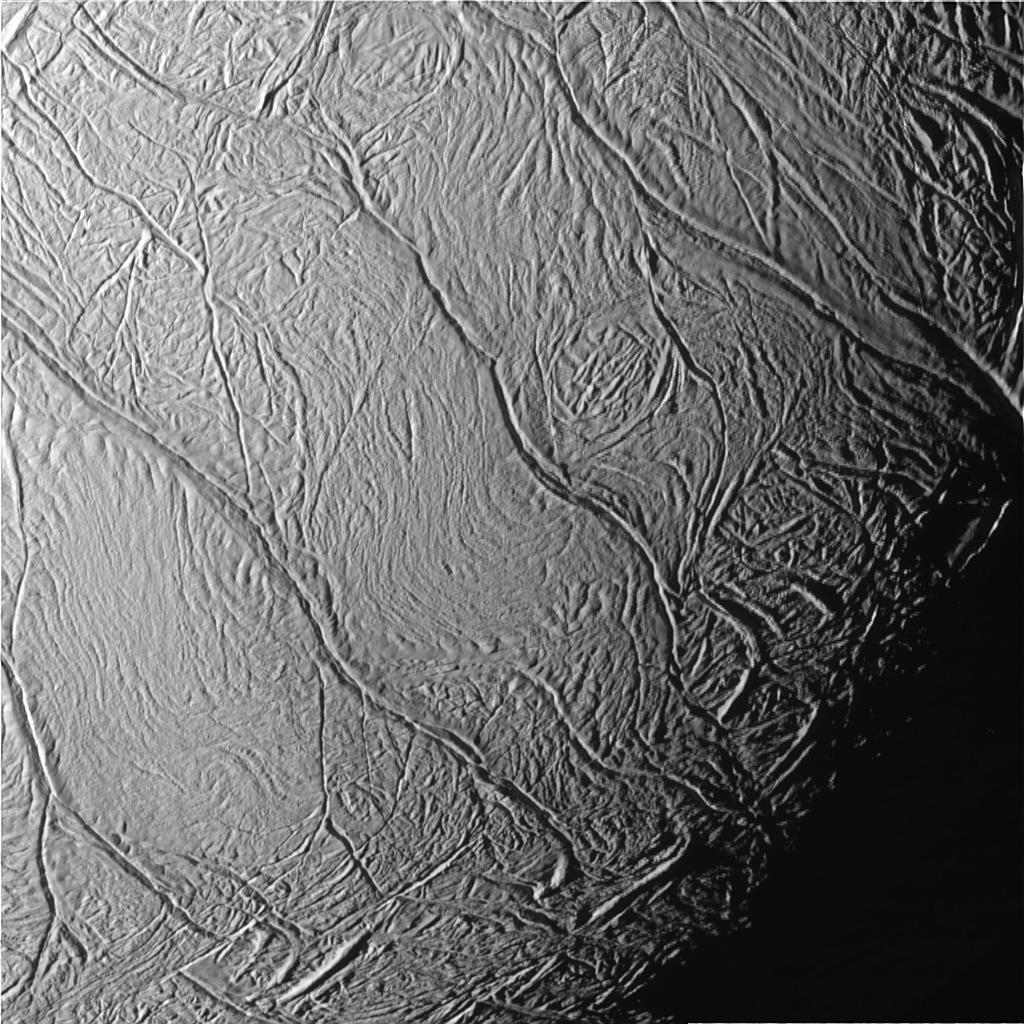
The cover photograph shows terrain at southern polar latitudes, observed by Cassini on 14 July 2005. Its elongated ridges and roughly parallel fractures belong to the landscape nicknamed the “tiger stripes”. This is a visible-light observation with enhanced contrast to bring out surface features, rather than an illustration of the interior. Shadows become prominent near the boundary between day and night. Looking at this image means looking at the actual surface. The hidden ocean, by contrast, is investigated through other measurements and comparisons with physical models of the moon’s interior.
How scientists detect water beneath a crust
A crucial result came in 2015 from studying libration: a slight change in the moon’s orientation as it travels around Saturn. Researchers compared the positions of surface landmarks in images collected over more than seven years. The measured wobble was too large for the crust and core to be rigidly connected. A compatible interior model required a global liquid layer separating them. Scientists were therefore not identifying blue water in a photograph. They were using the shell’s motion to investigate the hidden interior, bringing a measured displacement together with a physical explanation of what could produce it.
An orbit that helps supply heat
Enceladus completes two orbits while Dione, another Saturnian moon, completes one. This orbital resonance helps maintain Enceladus’s elliptical orbit. Its distance from Saturn changes, and tidal forces periodically deform the moon, generating internal heat. The interaction belongs to the same broad family of gravitational effects that produces tides on Earth, but operates in a different body and environment. A buried ocean therefore need not depend solely on sunlight arriving at the surface. Understanding it also requires looking at the dynamics of Saturn’s satellite system and the repeated deformation of the moon’s interior.
Tiny grains and evidence of hot water
In 2015 NASA described another clue: microscopic silica-rich particles detected by the Cosmic Dust Analyzer. Laboratory experiments and simulations pointed to an origin involving hot water interacting with rock, followed by cooling of the fluid. The studied conditions required temperatures of at least 90°C where the grains formed. That figure is not a measurement of the average temperature of the entire ocean. The interpretation concerns a possible hydrothermal environment on the seafloor, where water, minerals and heat interact. Scientists reconstructed that setting from the properties of the particles the spacecraft had actually detected.
Hydrogen as a source of chemical energy
Molecular hydrogen, written H₂, added an important piece of evidence. During the encounter on 28 October 2015, the INMS mass spectrometer collected measurements of plume gas; the result was presented in 2017. According to the Southwest Research Institute analysis, reactions between warm water and rock best explain the hydrogen detected. On Earth, some microorganisms obtain energy through chemical processes associated with hydrothermal environments. That comparison explains why researchers care about the gas. It remains a comparison with terrestrial processes, however, rather than proof that equivalent microorganisms inhabit Enceladus’s ocean beneath its icy surface.
Why an available resource does not prove life
The availability of chemical energy helps researchers discuss habitability: an environment’s capacity to support life. It does not automatically reveal whether living organisms are using that energy. NASA’s explanation of hydrothermal activity makes that distinction explicit: hydrogen can be present without biological activity. The scientific question goes beyond simply asking whether water exists. Researchers also need to understand which reactions occur, what substances are available and how they are replenished. Investigating favourable environmental conditions and identifying a biological signature are connected tasks, but they require different kinds of evidence before scientists can reach their conclusions.
Phosphorus inside icy grains
In June 2023, an analysis of Cassini data identified sodium phosphates in icy grains from Saturn’s E ring. Phosphates contain phosphorus, an element essential to terrestrial biological molecules, including those involved in genetic information and energy transfer. Experiments and geochemical modelling helped researchers interpret the finding in terms of the ocean’s composition. The direct observational result remains specific: the chemical signatures occurred in the analysed grains. Describing the availability of an essential ingredient is justified. Turning that ingredient into a discovery of a living cell would go beyond what those measurements establish about the moon.
Freshly ejected organic compounds
A later study, described by NASA in November 2025, examined particles collected directly within the plume during a 2008 encounter. Researchers identified a variety of organic compounds, including members of the ester and ether families. Freshly ejected particles are especially useful because they have spent less time in the space environment than older E-ring grains. “Organic” describes a chemical category here; it does not mean “made by an organism”. The scientific interest lies in the range of possible reactions and the connection between sampled material and the ocean, rather than an announcement of extraterrestrial life.
A plume that also shapes Saturn’s surroundings
Ejected material does not all end up in the same place. Some falls back onto Enceladus, while some supplies Saturn’s E ring. The moon’s bright surface and its surrounding environment are therefore connected with activity inside it. The discovery process is instructive too: the magnetometer detected an unusual interaction with Saturn’s magnetic field, encouraging closer observations. Photographs, field measurements, gas analysis and dust studies addressed different questions. No single instrument provided the entire story of the ocean. Their complementary results made it possible to connect the interior, the surface and material spreading into space.
Reading Cassini’s results today
The story of Enceladus developed in stages: activity observed in 2005, investigations of the interior, hydrothermal evidence, hydrogen and subsequent chemical analyses. Cassini’s mission ended in 2017, but its archived measurements continue to support new research. The publication date of a scientific study can therefore be much later than the observations on which it is based. When exploring this world, keep three things distinct: the material actually detected, the model explaining its origin and the still-open question of life. That documented chain of discovery is what makes this small, icy moon such a compelling place to study.
Sources and further reading (11)
- science.nasa.gov · enceladus
- science.nasa.gov · enceladus
- jpl.nasa.gov · pia06247 tiger stripes up close
- nasa.gov · cassini finds global ocean in saturns moon enceladus
- nasa.gov · spacecraft data suggest saturn moons ocean may harbor hydrothermal activity
- swri.org · swri scientists discover evidence habitable region within saturn s moon enceladus
- science.nasa.gov · hydrothermal activity
- nasa.gov · nasa cassini data reveals building block for life in enceladus ocean
- nasa.gov · nasa cassini study finds organics fresh from ocean of enceladus
- science.nasa.gov · cassini at enceladus a decade plus of discovery
- science.nasa.gov · the moon with the plume
Sources checked: 2026-11-17.