Plumes from below
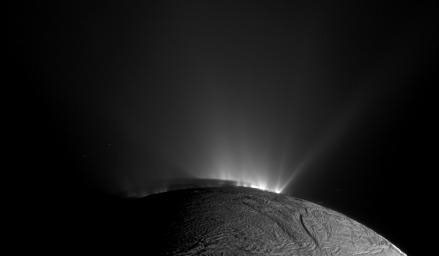
Cassini observed jets containing water vapour and ice particles. Measurements support the existence of an ocean beneath the icy crust.
Why scientists are interested
The plumes offer a way to study material from the interior without drilling through the ice. Water and chemical ingredients make Enceladus interesting for habitability research, but do not prove that life exists.
FACTS TO EXPLORE
Values are rounded. AU means astronomical unit. NASA source ↗
A wobble that reveals the interior
How can a moon’s motion reveal what lies inside it? Enceladus’s libration is a slight oscillation in its orientation. Researchers measured its amplitude by comparing surface landmarks in more than seven years of Cassini images. The result published in 2015 required an outer shell separated from the core by a global liquid layer: a rigid body would have wobbled less. The ocean can therefore be investigated through the moon’s mechanics as well as through its plumes.
Chemical ingredients and habitability
Cassini found salt-rich material in the plumes and E ring. The analysis announced in 2023 identified sodium phosphates in icy particles, adding phosphorus to the list of biologically important ingredients detected. These findings describe the chemistry of sampled material. Establishing that an environment could support life and demonstrating that it is inhabited require different evidence: life has not been detected on Enceladus. Archived measurements allow researchers to investigate these questions even after the mission has ended.
Sources and further reading (2)
- nasa.gov · cassini finds global ocean in saturns moon enceladus
- nasa.gov · nasa cassini data reveals building block for life in enceladus ocean
Sources checked: 2026-11-17.