A telescope must control its own heat
Observing the Universe in infrared light takes more than a large mirror. The observatory must also prevent its own heat from obscuring the signals scientists want to measure. The James Webb Space Telescope addresses that problem with an enormous sunshield, a structure open to space and dedicated cooling systems. Its unusual appearance follows a scientific requirement: collecting very faint light while limiting the signal generated by the observatory itself. Understanding how Webb stays cold therefore reveals an essential part of how it can see the objects that astronomers want to study.
Five membranes, rather than one thick blanket
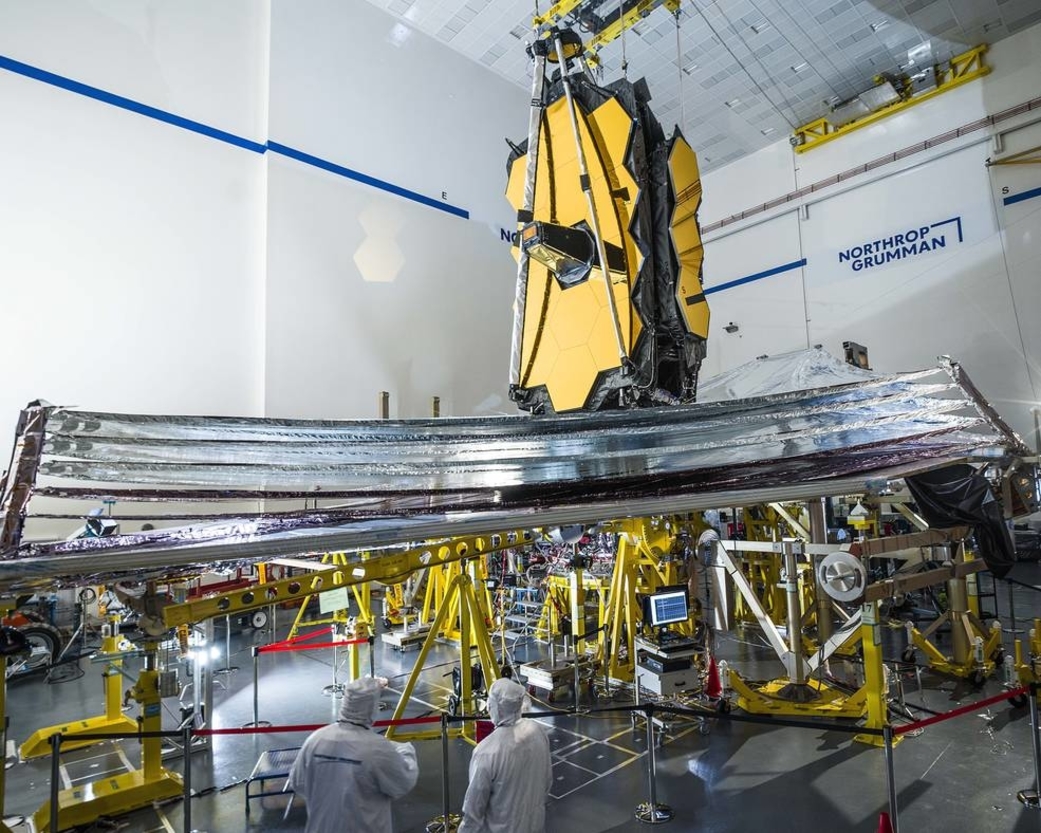
The sunshield consists of five extremely thin membranes, separated and held in a precise geometry. The first layer, facing the Sun, is 0.05 millimetres thick; the other four are 0.025 millimetres thick. These are not five heavy plates. Protection depends on the materials, coatings, spacing and shape. The layers have slightly different dimensions, and the gaps help direct energy outwards. Thinking of the shield as a simple insulating blanket therefore misses part of its function: the system also controls the directions in which heat can be radiated away from the observatory.
Materials designed to reflect and radiate
The membranes are made from Kapton, a polymer material, with aluminium coatings and treated silicon on the two hottest layers. The choice concerns optical and thermal properties as well as mechanical strength. Surfaces must manage incoming radiation and emitted heat without compromising the structure. The sunshield demonstrates how sophisticated an apparently passive component can be. A component does not need its own motor to perform a crucial task: its shape and material properties can provide an essential part of the observatory’s thermal control, working together with the rest of the spacecraft’s design.
Two sides with very different jobs
The sunshield divides the observatory into a warm side and a cold side. Spacecraft systems occupy the sun-facing region, while the mirrors and scientific instruments are protected on the other side. That separation allows components with different thermal requirements to operate together. When discussing Webb’s temperature, we consequently need to specify which part is being considered. A membrane, a spacecraft electronics unit and a detector are not the same physical object. Giving the entire telescope one temperature would erase the very distinction that its engineering design needs to maintain for successful science operations.
A successful deployment after launch
The sunshield was too large to fit inside the launch vehicle in its operational configuration. It was therefore folded and later opened in space through a controlled sequence of mechanisms. The mission team completed deployment on 4 January 2022. That milestone was a specific step in preparing for science, rather than an instant switch-on of every instrument. Unfolding, separating and tensioning the membranes correctly enabled the subsequent cooling process. It is one reason why a space telescope’s success begins well before the first scientific images are released to the public on Earth.
Why Webb observes near L2
Webb follows a solar orbit in the region of the second Sun–Earth Lagrange point, called L2. It does not remain motionless precisely at the point: it travels around it and uses propulsion corrections to maintain that orbit. The geometry allows the Sun, Earth and Moon to remain on the protected side of the sunshield. Its location is therefore connected with thermal management, as well as its distance from our planet. Describing L2 as a place where gravity disappears would be incorrect: gravitational interactions are precisely what make this orbital configuration useful for the observatory.
A structure open to space
A conventional telescope may use a tube to help exclude unwanted light. For Webb, however, an enclosure would introduce thermal problems: the tube’s surfaces would emit infrared radiation and hinder heat loss. The open design allows the scientific side to radiate energy into space, while the sunshield and other barriers control unwanted light sources. Passive cooling means using that architecture without relying entirely on a refrigeration machine. It is the result of a carefully arranged design, rather than an automatic property of any object sent into space to carry out astronomical observations.
MIRI needs to be colder still
The Mid-Infrared Instrument, abbreviated MIRI, observes longer wavelengths than Webb’s other instruments and requires detector temperatures below 7 kelvins. The kelvin measures absolute temperature: a temperature interval of one kelvin equals an interval of one degree Celsius, but the two scales have different zero points. Passive cooling alone cannot provide the required conditions. Webb carries a dedicated cryocooler for MIRI, transferring heat away from the sensitive components. The sunshield’s protection and active refrigeration are consequently complementary systems, rather than competing explanations of how the observatory keeps its infrared detectors cold enough.
Circulating helium and controlling vibration
The cryocooler uses helium as its working fluid in a closed circuit. It does not operate like a container of ice that is gradually used up: the fluid recirculates. NASA also describes the expansion of gas through a restriction to provide the final cooling needed. Another requirement is to limit vibration, which could disturb the optics. Pump movements are designed to counterbalance one another as much as possible. Astronomical refrigeration therefore has to meet two requirements together: removing heat while keeping the observatory stable enough to record sharp images of its scientific targets.
A measured milestone during commissioning
MIRI reached its operating temperature below 7 kelvins on 7 April 2022, as reported by ESA. That date belongs to the observatory’s commissioning and verification phase. The milestone matters because it documents that the cooling chain had achieved a condition required for operation. It does not describe the entire telescope reaching the same temperature. Reading a technical report means paying attention to the component measured and the stage of the operation. Those details connect an engineering result with the scientific capability that it makes possible for researchers using the instrument.
From cooling to data and colour
Scientific instruments turn collected light into data: images and spectra that allow signals to be studied at different wavelengths. Their detectors sit on the protected side, and thermal control helps make them suitable for measuring faint signals. The colourful images we admire then require processing: infrared measurements are assigned visible colours so that we can see them. The colour of a published picture is therefore not the telescope’s temperature. These are distinct parts of the explanation: the instrument’s operating conditions, the measurement of radiation and the way the results are presented to human viewers.
The photograph shows testing on Earth
The cover shows the real observatory during final sunshield tests on Earth in December 2020, credited to NASA/Chris Gunn. It is an archive photograph of the hardware, rather than a picture of Webb in its operational orbit. The tests checked membrane deployment and tensioning in an environment where Earth’s gravity had to be taken into account. Looking at that delicate structure makes its connection with science tangible: before measuring light from galaxies and planets, engineers had to build and deploy a system that could keep the instruments in the right operating conditions.
Sources and further reading (14)
- science.nasa.gov · how does webb stay cold
- science.nasa.gov · webbs sunshield
- science.nasa.gov · innovations
- science.nasa.gov · webbs 5 layer sunshield
- nasa.gov · sunshield successfully deploys on nasas next flagship telescope
- science.nasa.gov · orbit
- science.nasa.gov · telescope overview
- science.nasa.gov · cryocooler
- science.nasa.gov · webbs mid infrared instrument cooldown continues
- esawebb.org · weic2203
- science.nasa.gov · webbs scientific instruments
- science.nasa.gov · how are webbs full color images made
- nasa.gov · nasas webb sunshield successfully unfolds and tensions in final tests
- NIST · SI unit definitions
Sources checked: 2026-11-18.