A disc that is not solid
Saturn’s rings look like a continuous surface, almost a disc resting around the planet. They are actually a population of countless fragments, composed mainly of water ice alongside other material. The particles span a broad range of sizes: describing everything as “dust” conceals that variety. Light reaching a telescope combines contributions from enormous numbers of bodies that are too small or distant to distinguish individually. Understanding this distinction is the first step towards understanding the rings. What appears to be one structure is the collective appearance of many separate moving objects.
Each particle follows its own orbit
Every particle orbits Saturn. The rings do not turn like a rigid disc: orbital motion is faster closer to the planet than farther away. Fragments also collide, while their mutual gravity helps produce temporary clumps. Cassini’s explanations therefore describe a dynamic environment rather than a stationary ornament. Interpreting a photograph requires two levels to be considered together: the motion of individual objects and the structures emerging from their interactions. That connection makes the rings a natural laboratory for orbital mechanics, where the behaviour of many bodies produces patterns visible on a much larger scale.
Using letters and divisions to find our way
Ring letters do not simply run alphabetically outwards from the planet. Major regions include D, C, B and A, with the Cassini Division between B and A; additional structures lie farther out. The word “division” needs care too. The Planetary Data System catalogue describes narrow ringlets and further gaps within it: this is not a completely matter-free region. A scientific map distinguishes distribution, opacity and boundaries rather than treating every dark band as an absolute vacuum. Names and labels help us navigate a much more intricate arrangement than a few smooth circles suggest.
Daphnis, the little moon that raises waves
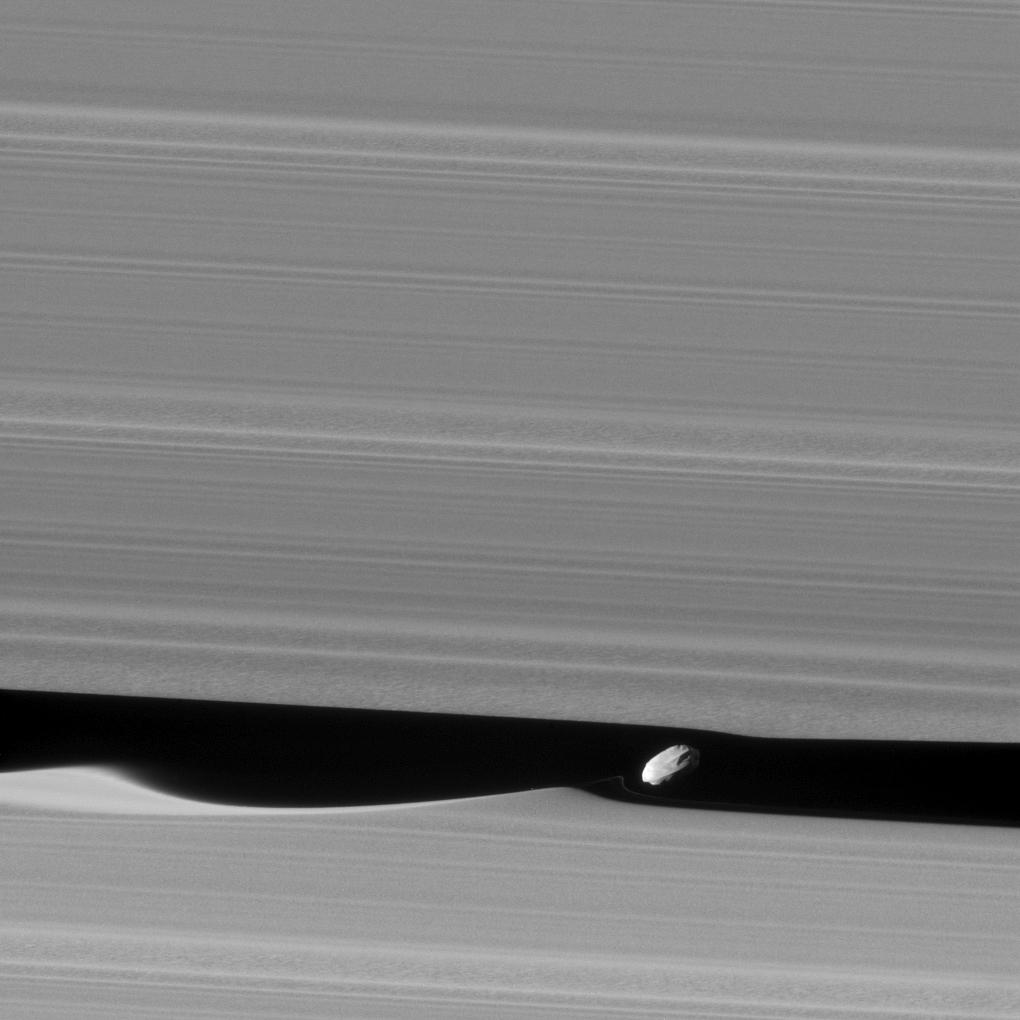
The cover photograph shows Daphnis in the Keeler Gap. Cassini recorded the view in visible light on 16 January 2017. The moon’s gravity disturbs the edges of the opening, generating waves both within the ring plane and vertically. These are not water waves: the moving material consists of orbiting fragments. Perspective matters as well, because the viewing angle makes the gap appear narrower. The photograph documents a physical relationship between a moon and the rings, but understanding it also requires the acquisition geometry and the description accompanying the measurement.
“Propellers” reveal hidden objects
Some small moons embedded in the rings are not identified as clearly resolved bodies. Instead, they are detected through disturbances in the surrounding material that resemble a propeller. The structure is not a machine and does not spin like an engine’s blades: the term describes the arrangement of material affected by gravity. In Cassini’s resource about the A ring, these disturbances become clues to objects that cannot be seen directly. This is a practical example of investigating a cause through its measurable effects, comparing the observations with models rather than mistaking the nickname for a literal description.
Equinox shadows reveal height
On 11 August 2009, sunlight reached the ring plane almost edge-on. Cassini could observe greatly elongated shadows, revealing vertical structures that were difficult to measure under different illumination. The principle is familiar: an object lit by a low Sun casts a long shadow. Here, however, the scene consisted of icy particles and structures disturbed by moons. Discovering local vertical relief showed why calling the rings “thin” does not mean treating them as perfectly flat everywhere. The illumination itself became part of the investigation, allowing researchers to extract information that ordinary viewing conditions had concealed.
A star behind the rings
During a stellar occultation, a star passes behind the rings as seen from the spacecraft. An instrument records changes in the light that passes through them. The Planetary Data System distinguishes these observations from radio occultations, which investigate a signal transmitted from the spacecraft towards Earth. Resolving every grain is unnecessary when measuring how strongly material obstructs light along a particular line of sight. Different instruments provide complementary information. Interpreted with the correct geometry, variations in the received signal become a profile of the properties of the material through which it has travelled.
Density waves and assigned colours
NASA’s resource Catching Saturn’s Ring Waves presents an image constructed from variations in starlight. Assigned colours make density differences recognisable; they do not represent what a colour camera would see. The illustrated structures include disturbances associated with the moons Janus and Pandora. A density wave describes changes in the concentration of material rather than a newly formed solid band. Knowing how the figure was produced explains what information it contains. An effective representation can be scientifically valuable precisely because it translates less intuitive measurements into a pattern that can be examined and compared.
Enceladus supplies the E ring
Not every ring resembles the bright, compact main bands. The E ring is much more diffuse and is connected with activity on Enceladus. Jets from the moon eject icy particles and gas into space, with some material contributing to the ring. The system is therefore not a collection of isolated features: a moon can supply an extended structure around its planet. This connection differs from the waves raised by Daphnis. One involves the transfer of matter, while the other primarily reveals a gravitational disturbance of material that is already present.
Spokes and an explanation still under investigation
Hubble observations from October 2023 showed temporary radial structures called spokes, resembling the spokes of a wheel. They are not physical supports holding up the rings. The leading explanation discussed by NASA involves tiny particles and electrostatic interactions associated with Saturn’s magnetic environment; the full mechanism remains under investigation. The distinction matters: the observed structures are data, while reconstructing the physical process requires further tests. The 2023 images provide a dated example rather than a live account of present conditions. Even after Cassini, instruments far from Saturn continue investigating its rings.
The Grand Finale took Cassini between planet and rings
In 2017, Cassini completed twenty-two orbits passing between Saturn and its rings before its final descent into the atmosphere on 15 September. That geometry opened a region no spacecraft had explored and enabled measurements different from ordinary distant imaging. The mission ended deliberately to prevent an eventually uncontrollable vehicle from contaminating scientifically important moons. Its spectacular pictures were therefore part of a wider programme involving measurements of fields, particles and radio signals too. Ending spacecraft operations did not remove the value of the observations already collected or the questions that researchers could investigate using them.
The archive preserves questions too
Studying the rings means comparing images, occultations and dynamical models, each with its own limitations. Cassini’s official archive organises observations and analysis tools to support those comparisons. A result extracted from shadows is not the same measurement as a light-transmission profile, even when both describe the same region. Agreement helps test an explanation; differences can suggest new questions. When looking at the rings, we can therefore seek more than beauty: evidence of how gravity and interactions between particles build structures in the environment surrounding a planet, and of how researchers learn to explain those structures.
Sources and further reading (11)
- science.nasa.gov · facts
- science.nasa.gov · faq
- pdsatmospheres.nmsu.edu · sci rings
- jpl.nasa.gov · pia21056 daphnis up close
- jpl.nasa.gov · pia21059 the propeller belts in saturns a ring
- science.nasa.gov · rings
- jpl.nasa.gov · cassini reveals new ring quirks shadows during saturn equinox
- nasa.gov · catching saturns ring waves
- science.nasa.gov · enceladus
- science.nasa.gov · nasas hubble watches spoke season on saturn
- science.nasa.gov · overview
Sources checked: 2026-11-20.