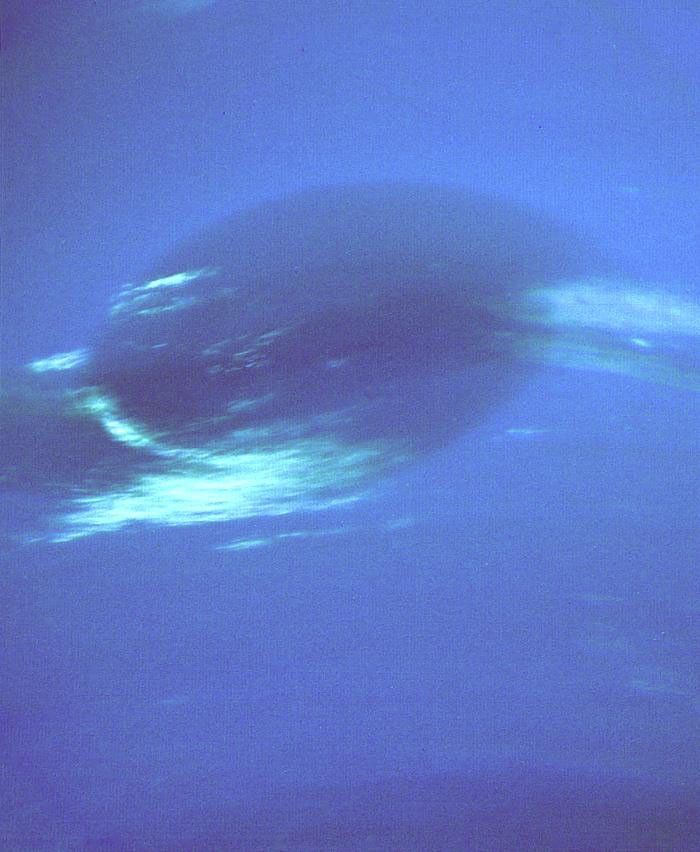
A cold world that refuses to stand still
Neptune is the eighth planet in the Solar System and the most distant of its eight major planets. Calling it an ice giant does not mean it is a ball of ice that we could walk on: its atmosphere extends deep inside and does not meet an Earth-like solid surface. Descriptions of its interior include materials such as water, ammonia and methane under pressures and temperatures very different from those in a freezer. To investigate this world, we mainly observe light from its atmosphere and track how it changes over time.
First the calculation, then the telescope
Neptune’s discovery in 1846 is a remarkable example of mathematics working with observation. Uranus’s measured orbit did not exactly match the prediction based on the planets already known. Urbain Le Verrier and John Couch Adams independently calculated the possible influence of another planet. Following Le Verrier’s prediction, Johann Galle found it through a telescope in Berlin. The decisive step was testing a quantitative prediction against the sky: a planet invisible to the unaided eye had left its gravitational signature in the motion of another world, making its presence detectable before it was recognised directly.
The flyby that changed our perspective
Voyager 2 reached Neptune in 1989 and remains the only spacecraft to have studied it at close range. A flyby differs from an orbital mission: the vehicle crosses the planet’s neighbourhood and continues its journey, rather than remaining there to observe for years. That encounter revealed details of clouds, rings and moons that were difficult to distinguish from Earth. Subsequent telescope observations therefore serve a complementary purpose: turning a close but brief encounter into a record of changes followed over decades, instead of treating the flyby as a permanent portrait of the planet.
The blue also depends on haze
Atmospheric methane absorbs some sunlight, contributing to the ice giants’ colour. Gas chemistry alone, however, does not provide the whole explanation. A model presented in 2022 combined observations from Gemini North, NASA’s IRTF infrared telescope and Hubble to describe several aerosol layers: tiny particles suspended in the atmosphere. In that model, thicker haze tends to make Uranus appear paler than Neptune. This is a physical reconstruction tested against observed spectra, rather than a direct measurement of the thickness of every cloud on the planet. It connects atmospheric structure with the light reaching our telescopes.
Why some photographs look much bluer
A scientific colour image can be assembled from exposures taken through different filters. The chosen balance and contrast affect the result. In 2024, a University of Oxford-led team reassessed Uranus’s and Neptune’s colours using spectroscopic observations from Hubble and the VLT, among other data. The planets proved more similar, both tending towards greenish blue, than many familiar images suggested. Historical processing of Neptune images often intensified the blue to emphasise atmospheric structures. Reading the image description is therefore part of interpreting the observation, rather than an optional detail separate from the science.
A close view of the Great Dark Spot
The cover shows the Great Dark Spot photographed by Voyager 2 during its 1989 encounter. Composite PIA00052 was made using the narrow-angle camera’s clear and green filters, about 45 hours before closest approach. Bright filaments mark clouds overlying the dark feature’s boundary. NASA’s description also records small patterns that changed quickly: the atmosphere was not a fixed drawing. Winds on Neptune can exceed 2,000 kilometres per hour. This photograph is a historical observation with colour processing, rather than a report of today’s weather or a view of a permanent landmark.
Storms can disappear
When Hubble observed Neptune in 1994, the two major dark features seen by Voyager in 1989 had disappeared. Other vortices were observed in subsequent years. A dark spot is therefore not necessarily the same object returning in every photograph. Monitoring allows researchers to follow its formation, movement and disappearance, and compare these events with atmospheric models. Research presented by NASA in 2019 describes how large bright clouds can accompany the development of such structures. Explaining a storm requires a dated sequence of observations, rather than a single dramatic image interpreted without its history.
The VLT adds a spectrum to the photograph
In 2023, ESO announced the first observation of a Neptune dark spot using a telescope on Earth. The Very Large Telescope’s MUSE instrument separated the light into different wavelengths. That spectrum helped investigate the feature’s depth within the atmosphere. The results favoured darkening particles in a layer beneath the main haze, rather than a simple gap between clouds. A nearby deep bright cloud was also observed. Spectroscopy can therefore distinguish phenomena that may look close together and similar in a photograph, by testing which wavelengths reveal them and what atmospheric levels those wavelengths probe.
Infrared observations reveal rings and high clouds
Webb images released in September 2022 showed the system’s narrow rings and dust bands with striking clarity. In the near infrared, Neptune looks different from visible-light photographs: methane absorbs strongly, making much of the disk dark. High clouds of methane ice, however, reflect light before it travels through the more strongly absorbing layers and can appear bright. Colours in infrared images are assigned to represent different filters. They do not mean Neptune suddenly changed its visible colour. Different observing wavelengths reveal different aspects of the same atmosphere and its surroundings.
A connection between clouds and the solar cycle
A study presented in 2023 compared almost three decades of Neptune observations with solar activity. The team found a correlation between the solar cycle and cloud abundance, with a delay of around two years after activity peaks. The interpretation involves photochemistry: chemical changes triggered by ultraviolet light. The release distinguishes this explanation from storms rising out of the deep atmosphere, which can complicate the picture. The correlation describes an observed pattern and an explanation requiring further investigation; it is not an automatic prediction of the clouds present today or a substitute for continued observations.
Webb also revealed auroras
In March 2025, NASA announced observational confirmation of Neptune’s auroras using Webb. The data had been acquired in June 2023, so the publication date differs from the observation date. The NIRSpec spectrograph detected characteristic emission from H₃⁺, a positively charged molecular ion containing three hydrogen atoms. The auroras appeared at geographic mid-latitudes, consistent with a magnetic field strongly tilted relative to the rotation axis. Observing this glow helps connect the upper atmosphere, energetic particles and the field’s geometry, extending the investigation beyond the cloud features that dominate more familiar photographs of the planet.
Triton completes the system’s portrait
Neptune’s largest moon, Triton, follows a retrograde orbit: it travels opposite to the planet’s rotation. This property supports the hypothesis that it was captured, rather than forming alongside Neptune in the same disk. During the 1989 encounter, Voyager 2 also observed active plumes on its frozen surface. These findings are distinct from observations of the planet’s storms: they concern another world with a thin atmosphere dominated by nitrogen. Investigating Neptune therefore means studying a system of different environments, connecting orbital dynamics, icy surfaces and atmospheric observations without treating them as interchangeable phenomena.
Sources and further reading (12)
- science.nasa.gov · neptune facts
- ssd.jpl.nasa.gov · discovery
- science.nasa.gov · exploration
- science.nasa.gov · why uranus and neptune are different colors
- ox.ac.uk · 2024 01 05 new images reveal what neptune and uranus really look 0
- science.nasa.gov · neptune great dark spot in high resolution
- science.nasa.gov · hubble tracks the lifecycle of giant storms on neptune
- eso.org · eso2314
- science.nasa.gov · new webb image captures clearest view of neptunes rings in decades
- science.nasa.gov · neptunes disappearing clouds linked to the solar cycle
- science.nasa.gov · nasas webb captures neptunes auroras for first time
- science.nasa.gov · triton
Sources checked: 2026-11-23.