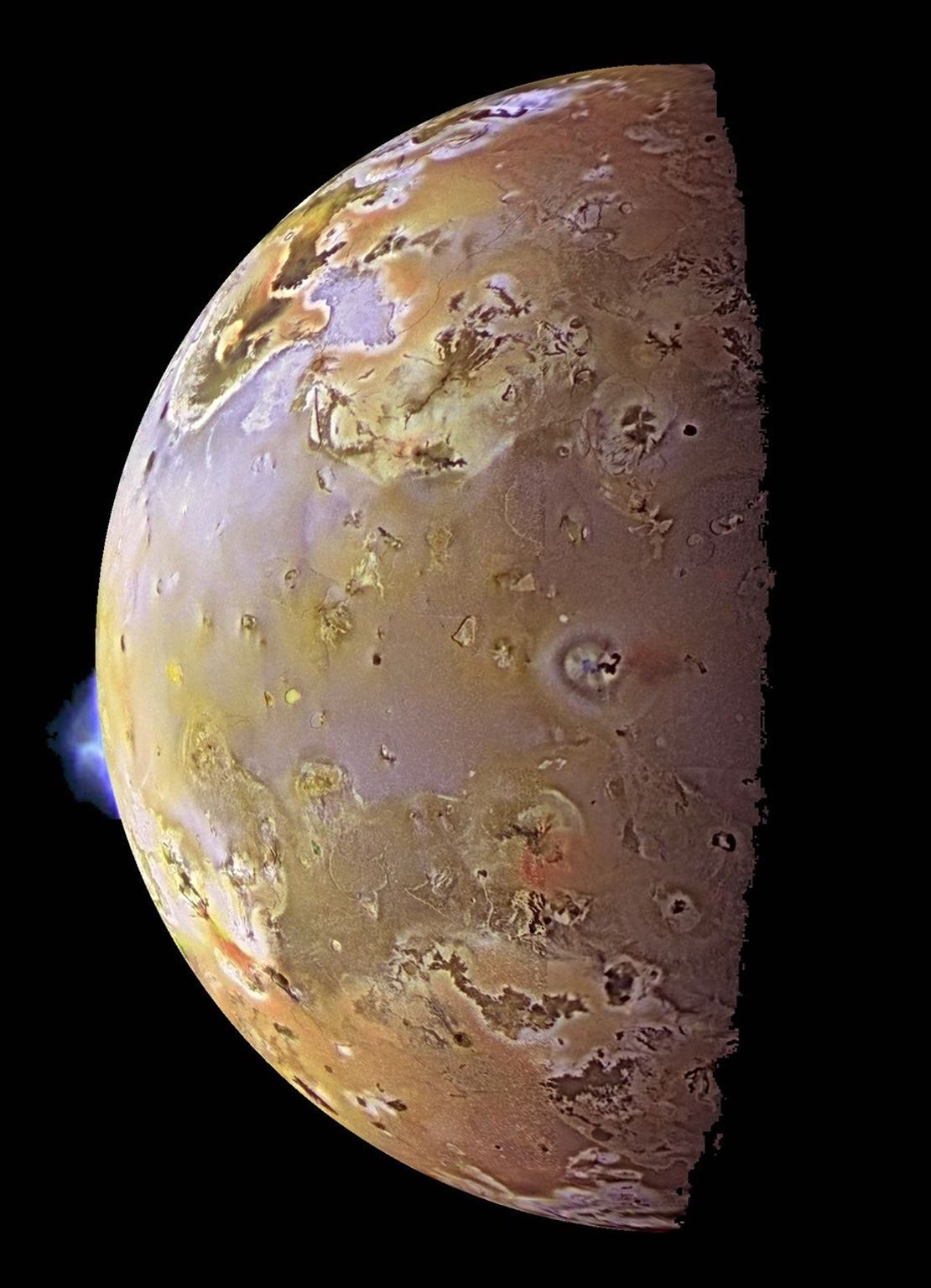
A rocky moon that renews its surface
Io is a rocky moon of Jupiter, slightly larger than our own Moon, and the most volcanically active world in the Solar System. Its landscape changes through lava flows, deposits and plumes, rather than preserving an ancient, motionless surface everywhere. It is not an icy moon like Europa: investigating it means following rock, gas and heat. Its distance from the Sun makes the question even more interesting. The energy powering its volcanoes does not simply come from sunlight. Its gravitational relationship with Jupiter and the neighbouring moons plays a decisive role.
Resonance keeps the tides in rhythm
Io, Europa and Ganymede follow orbits linked by a resonance. While Ganymede completes one circuit around Jupiter, Europa makes two and Io four. These repeated gravitational encounters help maintain Io’s slightly elliptical orbit. During each circuit, its distance from Jupiter and the stresses imposed by the planet change: the moon deforms, converting some mechanical energy into internal heat. These are tides within solid material, rather than simply the rise and fall of a sea. The orbital relationship therefore connects celestial dynamics with the processes taking place beneath the volcanoes.
The discovery began with a navigation image
In March 1979, Voyager 1 images revealed that volcanism was more than a theoretical possibility. Linda Morabito identified a feature extending beyond Io’s disk while working with images used for spacecraft navigation. Project scientist Ed Stone’s account describes the moment as one of the mission’s great surprises. The observed feature was an erupting plume: direct evidence of activity beyond Earth. An image collected to help establish a trajectory therefore became a geological record as well. It illustrates how engineering and scientific discovery can complement each other, even when the original purpose of an observation is quite practical.
Two plumes in Galileo’s photograph
The cover is NASA composite PIA01081, assembled from Galileo observations. Its colours derive from green, violet and near-infrared filters; images from 28 June 1997 were combined with a more detailed mosaic collected during different orbits. It is therefore not a single natural-colour exposure. Pillan Patera’s plume appears on the illuminated limb; near the boundary between day and night, Prometheus’s plume can also be recognised through its shadow. Comparing plume, shadow and terrain shows why illumination geometry is part of scientific interpretation, rather than merely a choice that makes a photograph more dramatic.
A new dark patch records an earlier eruption
In 1997, Galileo observed a major change around Pillan Patera by comparing April and September images. A dark deposit roughly 400 kilometres across had appeared where the terrain previously looked different. Colour differences suggested a composition unlike that of many pale or reddish deposits rich in sulphur compounds. Researchers discussed the possibility of more silicate-rich material, from the mineral family common in terrestrial rocks. Colour provided a clue to interpret alongside other data, rather than a direct chemical analysis of a sample collected on the ground. Dated comparisons turned an image into evidence of change.
Infrared observations reveal lava lakes
Juno’s Italian JIRAM instrument measures infrared radiation. Analyses presented in 2024 showed many volcanic centres with hot edges around a relatively cooler central surface. Researchers interpreted the pattern as a lava lake with a crust breaking near the walls, exposing hotter material. An infrared-dark area is not necessarily dark in a visible-light photograph: the quantity measured here is thermal emission. Comparing the two wavelength ranges connects terrain shape with heat distribution, without confusing colours assigned to the data with the landscape’s visible colours. Different instruments reveal different aspects of the same volcanic feature.
Hot rings test more than one explanation
The original study of thermal rings compared different explanations for how they work. One possibility involves magma rising at the centre and a surface crust moving towards the margins. Another involves changes in lake level, with piston-like vertical motion. The observations analysed did not show recent flows on the flanks of the investigated structures, suggesting that the lake level was not overtopping the rim at those times. The observed pattern therefore constrains the models, but does not automatically select a single mechanism for every lava lake on Io. Further observations are needed to distinguish how individual systems behave.
Radio tracking also measures the interior’s response
Juno’s close passes in December 2023 and February 2024 enabled an experiment different from photography. Ground antennas tracked the spacecraft’s radio signal and tiny velocity changes influenced by Io’s gravity. Analysis published in December 2024 investigated how the moon responds to tidal deformation. An interior separated by a shallow global magma ocean would produce a different response from a predominantly solid structure. The result comes from comparing measurements with models of the interior, rather than using a camera able to see through the crust. Radio science adds information unavailable from the appearance of volcanic terrain alone.
No shallow global ocean does not mean no magma
The original paper concludes that the data exclude a shallow global magma ocean in the configurations investigated. That qualification matters: the findings do not exclude local melting or reservoirs supplying volcanoes. Nor do they establish that every detail of the interior is now known. Measuring the tidal response helps distinguish broad families of physical structures; individual conduits exist on another scale. Respecting that distinction moves beyond the oversimplified picture of an entirely liquid moon without replacing it with the equally misleading idea of a completely cold, rigid body. Volcanism and a largely solid interior can coexist.
The major event observed in December 2024
In January 2025, NASA described intense activity observed by JIRAM on 27 December 2024 in Io’s southern hemisphere. The infrared signal was strong enough to saturate the detector. Data indicated several nearby hot spots active simultaneously, suggesting a possible connection between underground reservoirs. Visible images also showed surface changes. The description of an exceptional event concerns those observations, rather than a continuous measurement of the volcano today. Acquisition date, announcement date and interpretation of subsurface connections must remain distinct to understand what was actually discovered and how the evidence supports the proposed explanation.
An atmosphere that changes during eclipse
Io has a very tenuous atmosphere made mainly of sulphur dioxide. Observations described by NASA in 2016 showed a strong reduction in gas when the moon entered Jupiter’s shadow: cooling encouraged sulphur dioxide to deposit as surface ice. On returning to sunlight, sublimation helped rebuild the atmosphere. The term collapse does not mean the moon deforms or that every molecule disappears. It describes an atmospheric change involving temperature, ice and gas. This is another reason to specify observing conditions alongside the date and instrument, rather than treating a single atmospheric measurement as permanent everywhere on the moon.
The volcanoes contribute to Jupiter’s environment
Some material originating from Io becomes ionised and supplies a plasma torus around Jupiter. Plasma is matter containing charged particles; torus describes a doughnut-like distribution around the orbital region. Representations often show a blue cloud and coloured lines connecting the system with the planet’s magnetosphere. These illustrate data and fields, rather than photographing glowing threads in space. Io is therefore a laboratory where geology, atmosphere and particle physics meet: one moon’s volcanism can influence the environment of an entire planetary system. Its importance extends beyond the lava flows visible on its own surface.
Sources and further reading (12)
- science.nasa.gov · facts
- esa.int · the orbits of the galilean moons
- science.nasa.gov · ed stone
- science.nasa.gov · color mosaic and active volcanic plumes on io
- jpl.nasa.gov · galileo finds arizona sized volcanic deposit on io
- nasa.gov · nasas juno gets a close up look at lava lakes on jupiters moon io
- nature.com · s43247 024 01486 5
- nasa.gov · nasas juno mission uncovers heart of jovian moons volcanic rage
- nature.com · s41586 024 08442 5
- nasa.gov · nasa juno mission spots most powerful volcanic activity on io to date
- nasa.gov · new research reveals fluctuating atmosphere of jupiters volcanic moon
- science.nasa.gov · the jupiter io system and interaction illustration
Sources checked: 2026-11-27.