A distance that changes along the orbit
The Earth–Moon distance is not an unchanging measurement to learn by heart. The lunar orbit is elliptical, so our natural satellite moves closer to and farther from Earth during its journey. An average value describes the orbit as a whole, whereas a distance at a particular instant also needs a time and a geometrical reference. This distinction avoids a common misunderstanding: two different numbers can both be correct when they describe different moments or quantities. Understanding how we measure the Moon therefore begins with asking exactly which distance we want to determine.
Light’s outward and return journey
Lunar Laser Ranging, abbreviated to LLR, uses light pulses sent from a ground station towards retroreflectors on the lunar surface. A telescope collects the returning signal, and instruments measure its time of flight. This determines distance through a timing measurement, rather than through a photograph that already contains a kilometre scale. The useful returning signal can consist of just a few photons, the particles of light. CDDIS archives collect these observations. Analysing them reveals information about the lunar orbit, rotation, solid-body tides and reflector locations, connecting individual experiments with a physical description of our natural satellite.
In a vacuum, the speed of light, denoted by c, is exactly 299,792,458 metres per second: the International System fixes that numerical value through the definition of the metre. In the elementary expression d = c × Δt / 2, Δt is the round-trip time; dividing by two separates the outward journey from the return journey. An exact constant does not automatically make every experiment perfect, however. Defining a unit and evaluating an instrument’s performance are different tasks: the measured time and the corrections applied to it still have their own uncertainties.
Why retroreflectors matter
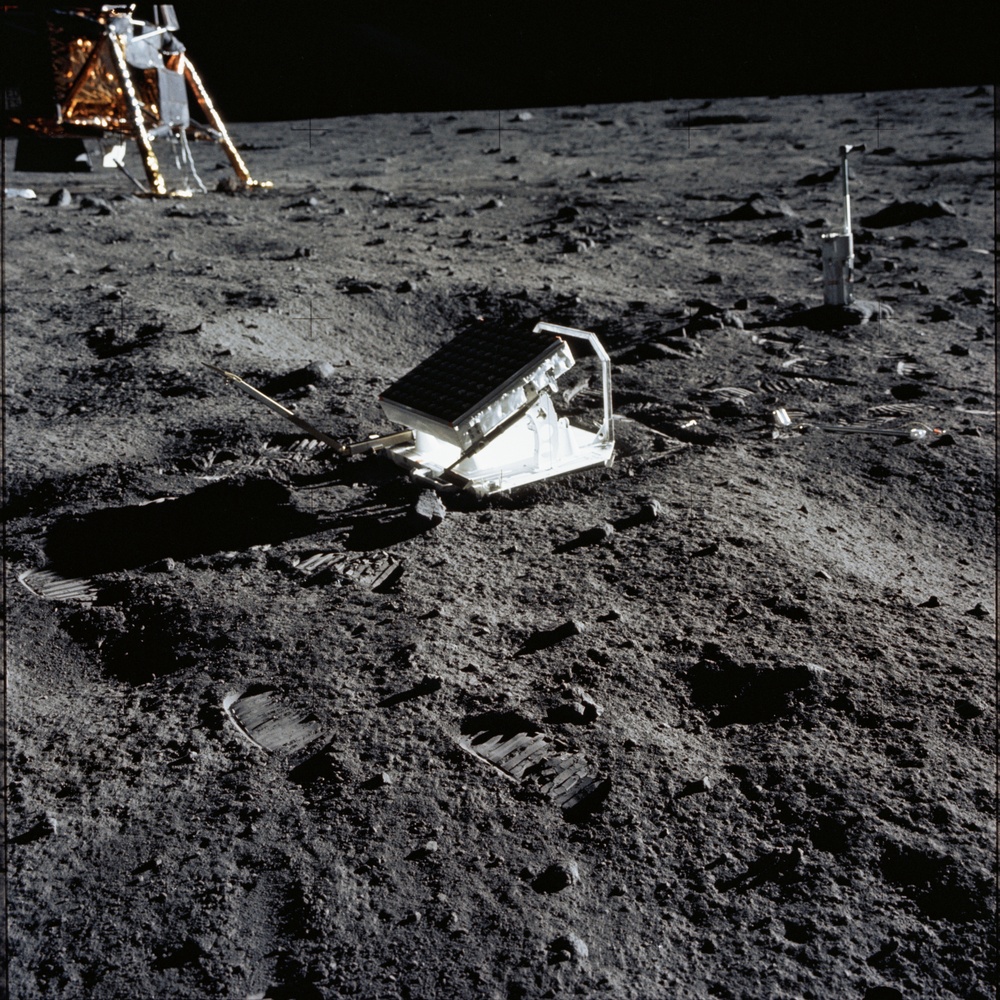
Apollo panels contain corner-cube prisms that return light towards the direction from which it arrived. The Apollo 11 and Apollo 14 arrays each contain one hundred elements, while the Apollo 15 array contains three hundred. Soviet Lunokhod rovers also carried retroreflectors to the Moon. These are identifiable targets at specific locations: ranging to a known array is different from illuminating an unspecified landscape full of rocks and changes in elevation. The reflector’s geometry is an essential part of the measurement system, rather than simply a photographic prop left behind by astronauts on the surface.
One of the panels’ most elegant features is that they need no electrical power to reflect incoming pulses. The active equipment remains on Earth, where lasers, telescopes, detectors and analysis systems can be improved. A simple lunar target has therefore connected observations made across decades and generations of instruments. NASA’s account of the Apollo experiment also explains how ranging helps determine the Moon’s orbit and orientation. That information matters when interpreting observations made by spacecraft studying our neighbour at close range, as well as when connecting measurements taken at different times.
Why collecting the signal is difficult
The distance and weakness of the returning signal make the experiment demanding. In 2020 NASA described a successful return from a retroreflector mounted on the Lunar Reconnaissance Orbiter, a target distinct from the panels on the ground. Comparing an orbiting target with surface arrays can help investigate the behaviour of reflectors whose signals have weakened over time. Dust and thermal conditions are among the factors researchers examine. Knowing that a device is still present is therefore not enough: scientists measure its response and compare physical explanations that are consistent with the observations.
Precision also requires many observations. The APOLLO experiment’s technical explanation shows that a single photon cannot, on its own, define a millimetre-precision distance: pulse duration and array geometry matter, while collecting many returns improves the statistical estimate. Nor does the telescope remain motionless relative to Earth’s centre: rotation, plate motion and tidal deformation change the station’s position. The initial observation therefore concerns a particular observatory and a particular target. Deriving a distance between the centres of the two bodies requires a geometrical and physical analysis of those reference points.
From a pulse to a scientific archive
Laser observations are not handled simply as a list of isolated numbers. The International Laser Ranging Service distinguishes full-rate data from normal points, condensed observations formed from measurements collected over an interval. Data preparation also includes atmospheric corrections and station calibration. Preserving formats and associated information makes it possible to compare results obtained under different observing conditions. An archive’s scientific value comes from being able to reconstruct how a measurement was made, rather than merely reading a distance stripped of the experimental context needed to interpret and evaluate it.
The network is not a single telescope or a single agency. The ILRS resource directory includes observatories such as Apache Point, Wettzell, the Observatoire de la Côte d’Azur and the Matera Laser Ranging Observatory, alongside groups that analyse their data. This separates two complementary tasks: obtaining a usable optical return and interpreting it within a model of the Earth–Moon system. Following links to the observatories and analysis centres gives interested readers a concrete way to discover where the measurements originate and how they become scientific results available to a wider research community.
What the Moon tells us
The long observation record allows researchers to study the orbit’s evolution. ILRS reports lunar recession of about 3.8 centimetres per year, associated with tidal dissipation in the Earth–Moon system. This is a trend derived from an extended record, not a uniform increment to add every second to a website counter. Ranging also contributes to studies of the lunar interior, reference systems and gravity. An experiment based on light therefore connects several different phenomena: orbital motion, the deformation of the bodies involved and tests of general relativity within our Solar System.
Small retroreflectors intended for modern landers should not be confused with miniature copies of the entire Apollo experiment. NASA’s description of Laser Retroreflective Arrays explains how optical markers can be interrogated by an orbiting spacecraft to locate a lander. The measurement geometry and instruments can therefore differ from the familiar link between an Earth observatory and a lunar array. Reflection remains useful in several configurations, but a clear explanation identifies which instrument sends the pulse, which target returns it and where the returning light is received and timed.
How to read the website’s distance counter
Ephemerides, including those supplied by NASA/JPL Horizons, describe positions and motion as functions of time and the chosen reference frame. Universo Facile’s data bar uses official vectors to calculate an updated geometric distance by interpolating between valid time samples. It is not receiving a fresh laser pulse from the Moon whenever a digit changes. The three displayed decimal places help show the calculation evolving, but do not certify metre-level accuracy.
Sources and further reading (12)
- NASA · Moon Facts
- NASA/CDDIS · Lunar Laser Ranging data
- NIST · SI unit definitions
- ILRS · Apollo and Lunokhod reflectors
- NASA · The Apollo experiment that keeps on giving
- NASA · Laser-ranging experiments with LRO
- UCSD/APOLLO · The basics of lunar ranging
- ILRS · Data and normal points
- ILRS · Observatories and analysis centres
- ILRS · Lunar Laser Ranging science
- NASA · Retroreflectors for lunar missions
- NASA/JPL · Horizons manual
Sources checked: 2026-11-16.