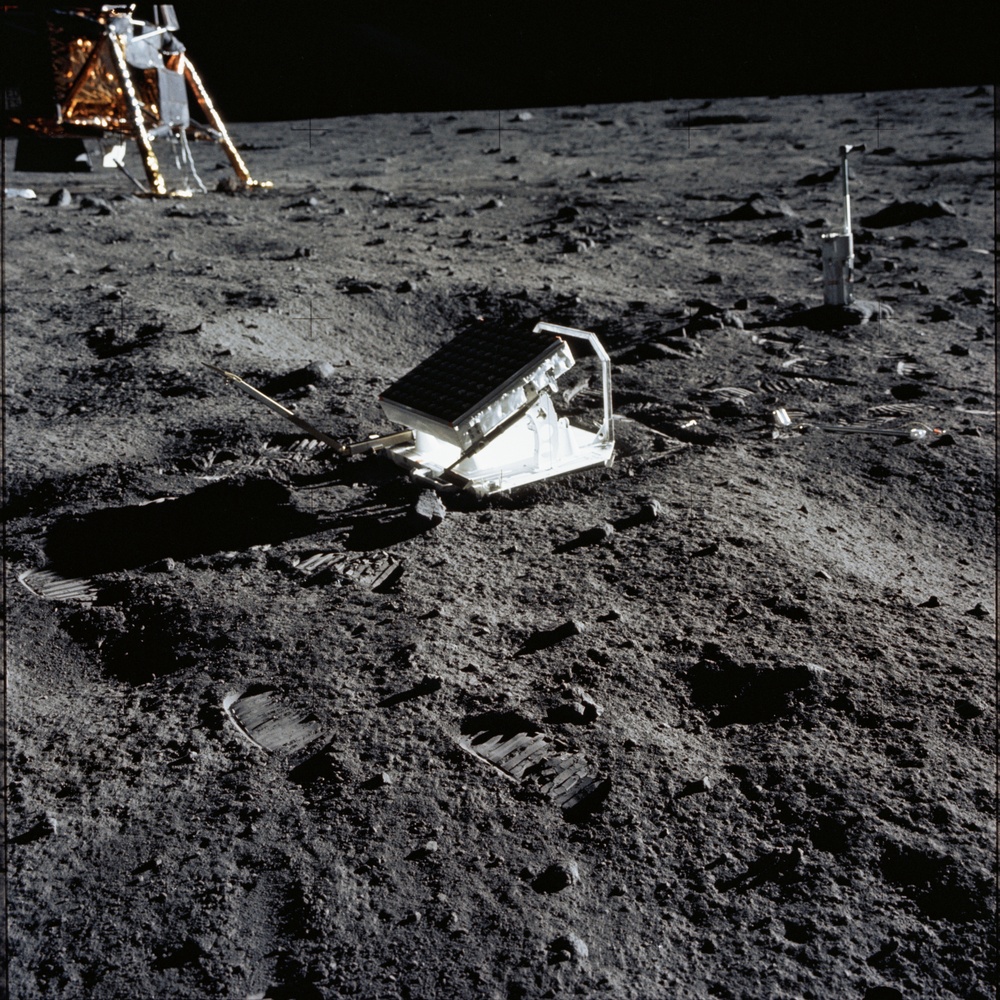
How far away is the Moon? A precise answer can begin with a pulse of light. Lunar Laser Ranging, or LLR, measures the time light takes to reach a lunar retroreflector and return to a telescope on Earth. This is not a distance estimated from a photograph: it is a measurement of light’s journey. The method in the NASA/CDDIS archive.
A stopwatch for light
A station sends a short laser pulse and records the return of a small part of the signal. The basic relationship is distance = speed of light × round-trip time ÷ 2. Dividing by two accounts for the outward and return journeys. Precision clocks therefore turn a time interval into a distance. The experiment in NASA’s educational activities.
The special mirrors left by Apollo
Retroreflectors send light back towards the direction it came from. The Apollo 11 panel contains 100 fused-silica elements called corner cubes; Apollo 14 has a similar array, while Apollo 15’s contains 300. These are not large steerable mirrors: the geometry of the individual elements makes the returning signal useful. Instrument specifications from ILRS/NASA.
Which distance are we measuring?
The measured path runs between a station and a particular reflector, rather than directly between the centres of Earth and the Moon. Stating the endpoints matters: two values are not necessarily comparable just because both are expressed in kilometres. The same principle can measure distances between spacecraft and surface reflectors. Reflectors and mission positioning.
Why repeat the measurement for decades?
The return takes about 2.5 seconds on average: an explanatory reference, not a fixed time for every observation. Long measurement records reveal extremely slow changes. One is the Moon’s average recession of about 3.8 centimetres per year, linked to its gravitational interaction with Earth. The scientific result comes from comparison over time, rather than from a single flash. Laser-ranging results and challenges.