NASA mean radius.
Getting to know Venus
A dense atmosphere, made mostly of carbon dioxide, traps heat through a strong greenhouse effect. Clouds hide the ground in visible light, but radar can reveal its topography.
Exploration and missions
The Magellan spacecraft used radar to map much of the surface and study volcanoes, plains and geological structures hidden beneath the clouds.
FACTS TO EXPLORE
Values are rounded. AU means astronomical unit. NASA source ↗
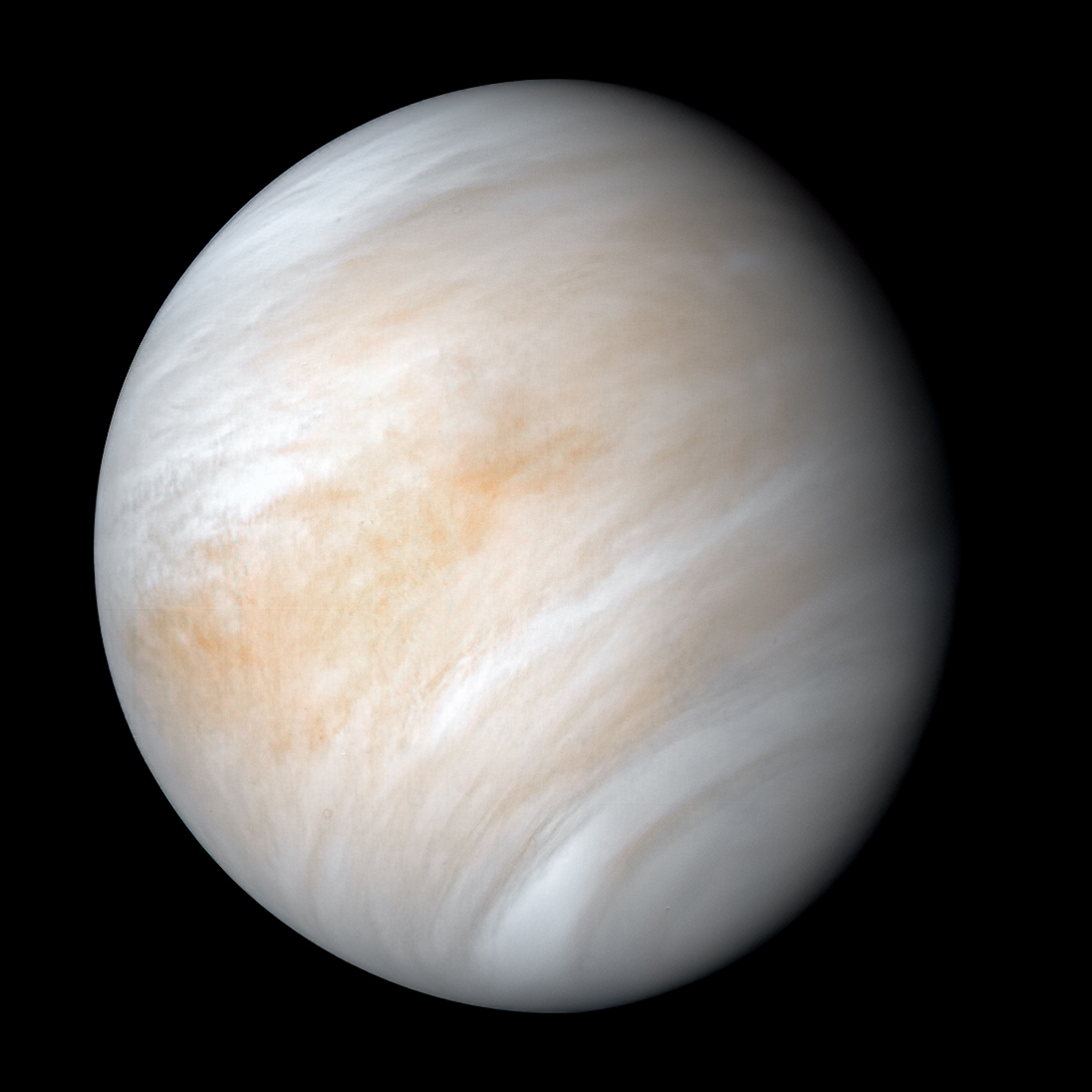
A greenhouse effect on a grand scale
Venus’s atmosphere is composed mostly of carbon dioxide, and its surface pressure is extremely high. Sunlight warms the planet; the atmosphere absorbs and re-emits some of the energy radiated by the surface, slowing heat loss. This powerful greenhouse effect helps make Venus hotter than Mercury, even though Venus is farther from the Sun. A planet’s distance from its star alone is not enough to predict its climate.
Looking beneath the clouds
Venus’s clouds hide the ground in visible light. To map it, Magellan sent radar pulses towards the surface and measured the returning signal: a way of “seeing” with radio waves rather than taking visible-light photographs. The topography reveals volcanoes, plains and deformed structures. Comparing different observations helps researchers investigate how and when the surface changed and whether some processes remain active.