NASA mean radius.
Getting to know Uranus
Uranus’s axis is tilted by about 98 degrees from the direction perpendicular to its orbital plane. This geometry produces unusual seasons during its long journey around the Sun.
Exploration and missions
Voyager 2 made a close flyby in 1986. Ground- and space-based telescopes continue to observe the atmosphere, rings and moons.
FACTS TO EXPLORE
Values are rounded. AU means astronomical unit. NASA source ↗
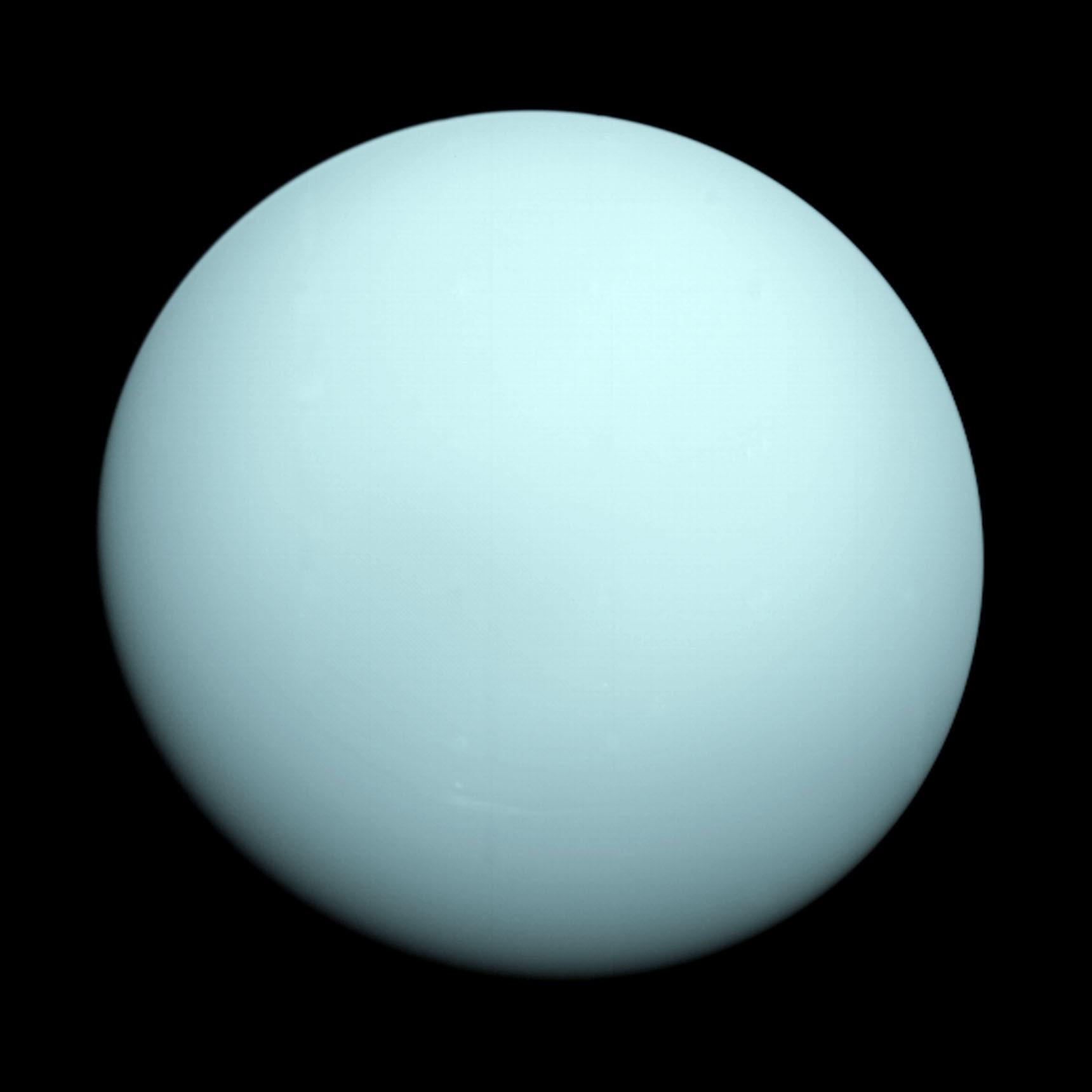
A planet tipped on its side
Uranus’s rotation axis is strongly tilted relative to its orbit. As a result, its poles receive sunlight very differently over the long Uranian year. Seasons depend not only on distance from the Sun, but also on a planet’s orientation. A globe and a lamp can help illustrate this: tilt the axis and the part that stays illuminated changes as the globe moves around its orbit.
What does “ice giant” mean?
In planetary science, “ices” can refer to substances such as water, ammonia and methane, not necessarily solid ice like the kind in a freezer. Conditions inside ice giants are extreme and cannot be observed directly. Scientists combine gravity, magnetic-field and atmospheric measurements to build models. Voyager 2 flew past Uranus; telescopes and new observations continue to study it from afar.