NASA mean radius.
Getting to know Saturn
The rings contain countless fragments of different sizes, mostly ice. Like Jupiter, Saturn is made mainly of hydrogen and helium.
Exploration and missions
Cassini studied Saturn, its rings and moons. Titan and Enceladus are very different worlds, both important for understanding chemistry and oceans beyond Earth.
FACTS TO EXPLORE
Values are rounded. AU means astronomical unit. NASA source ↗
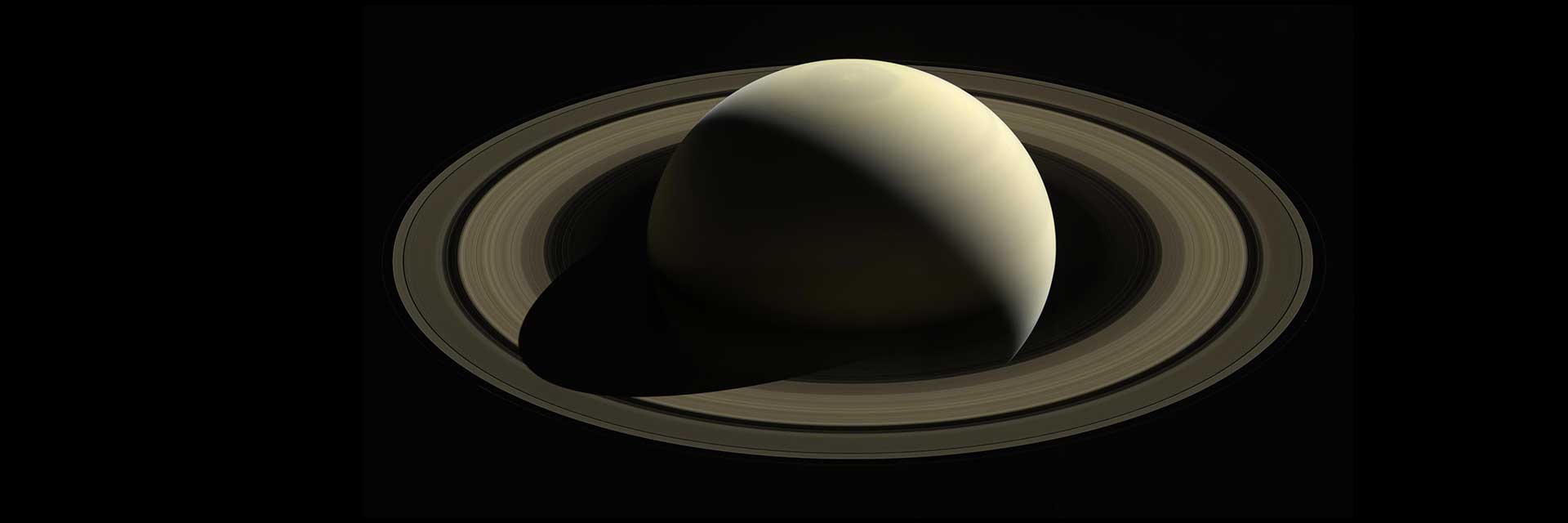
The rings are not solid discs
From a distance the rings look continuous, but they consist of countless orbiting particles, mostly ice. The particles vary in size, and the gravity of moons helps shape some structures and gaps. Studying light passing through the rings and signals from spacecraft lets scientists reconstruct their distribution, even where individual fragments cannot be resolved.
Two moons, two worlds
Titan has a dense atmosphere and liquid hydrocarbons that flow and collect on its surface. Enceladus is much smaller, yet releases plumes of material from its southern polar region. Cassini flew through and studied those plumes, contributing evidence for an internal ocean. These are different environments: comparing them shows how varied worlds orbiting the same planet can be.