NASA mean radius.
Getting to know Neptune
Despite its great distance from the Sun, Neptune has very fast winds and dynamic cloud systems. Methane contributes to its blue colour by absorbing some red light.
Exploration and missions
Voyager 2 flew past Neptune and its moon Triton in 1989. Observations from Earth and space continue.
FACTS TO EXPLORE
Values are rounded. AU means astronomical unit. NASA source ↗
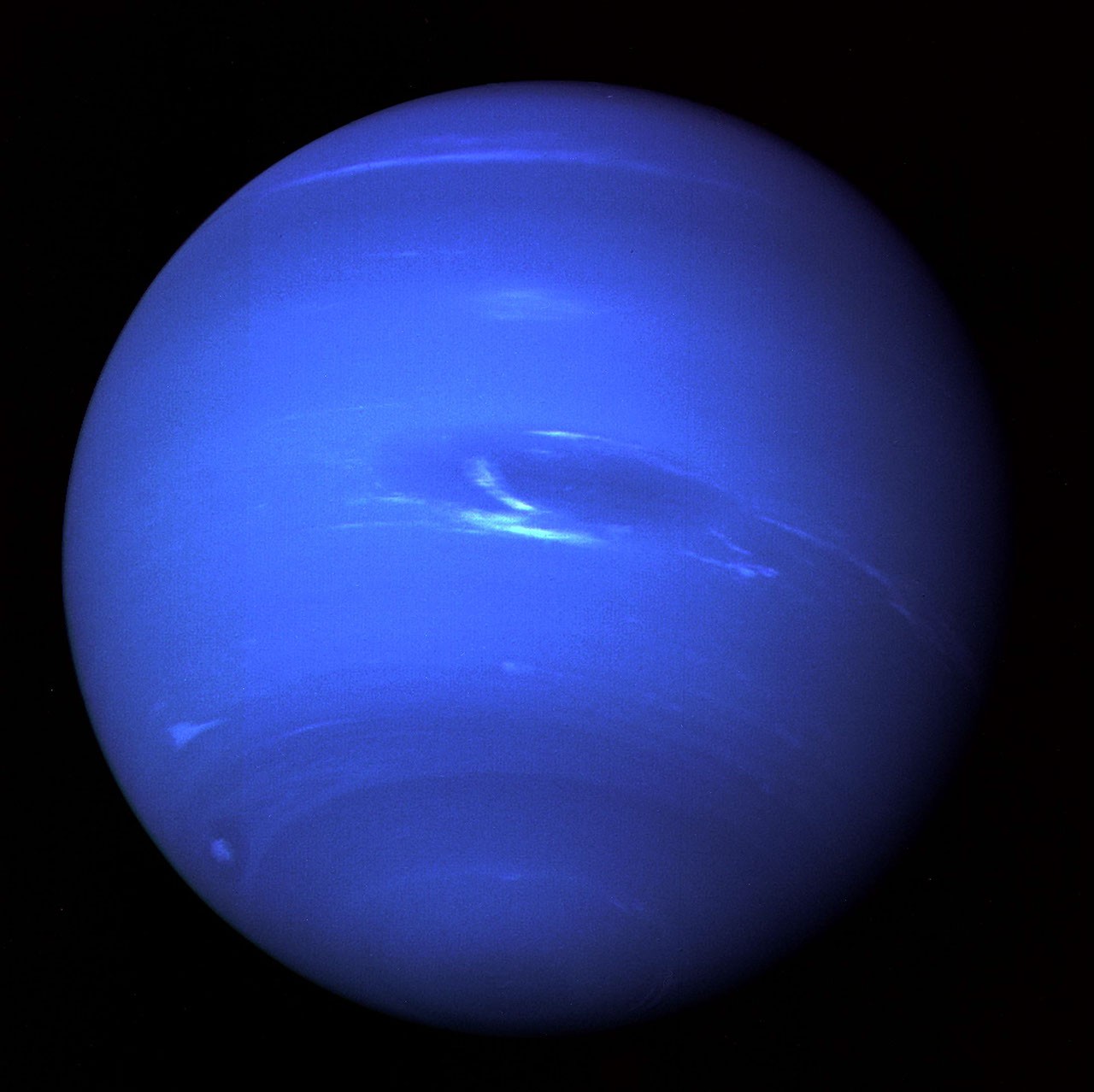
Winds in the outer Solar System
Neptune receives much less solar energy than Earth, yet its atmosphere has clouds, storms and extremely fast winds. The clouds we see are the visible part of complex atmospheric dynamics. Images at different wavelengths help researchers study different layers and components; processed colours do not always match what a human eye would see.
A discovery guided by mathematics
Before Neptune was directly observed, astronomers studied irregularities in Uranus’s motion and calculated where to look for a possible planet perturbing its orbit. Observation then confirmed Neptune’s presence: an example of the dialogue between mathematical models and telescopes. Voyager 2 flew past Neptune and also observed Triton; telescopes continue to track changes in the planet and its atmosphere.