NASA mean radius.
Getting to know Mercury
Mercury follows the innermost orbit of the planets. It has a tenuous exosphere and extreme temperature swings: being close to the Sun does not mean that its entire surface is always hot.
Exploration and missions
NASA’s MESSENGER orbited Mercury. BepiColombo, a mission by ESA and JAXA, is dedicated to studying the planet and its environment.
FACTS TO EXPLORE
Values are rounded. AU means astronomical unit. NASA source ↗
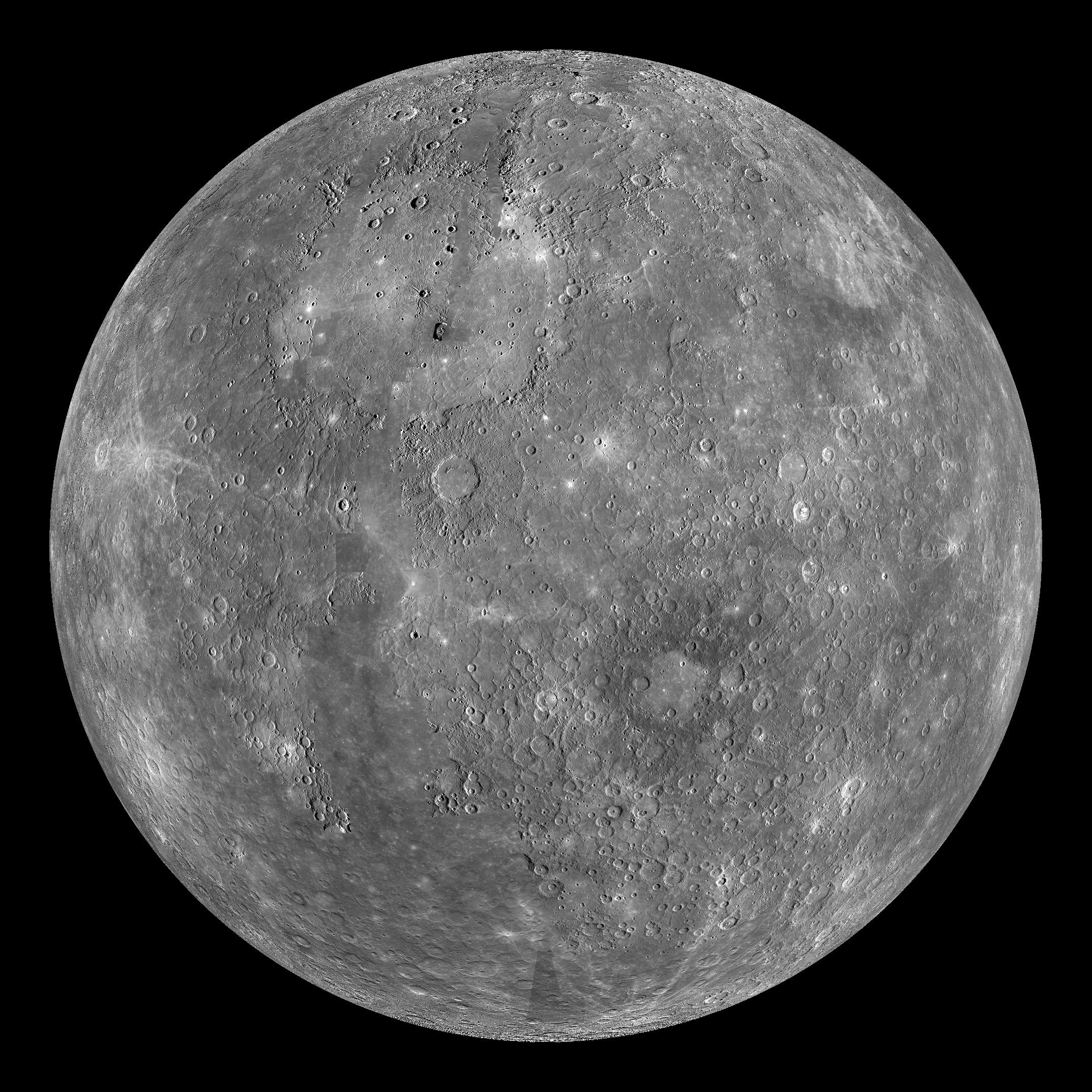
A planet of contrasts
Mercury preserves an ancient surface marked by craters created by asteroid and comet impacts. Smoother regions also tell a story of volcanic activity. Long cliffs, like steps in the crust, are clues that the planet contracted as its interior cooled. Scientists compare crater shapes and the distribution of materials to reconstruct the sequence of events.
Ice near the Sun?
Mercury’s exosphere is extremely thin: its particles are so sparse that they do not behave like Earth’s air. It retains heat poorly, so temperatures change greatly between day and night. In permanently shadowed polar craters, however, observations indicate water ice. There is no contradiction: what matters is how much sunlight reaches a particular place, not just the planet’s average distance from the Sun.