NASA mean radius.
Getting to know Jupiter
Jupiter is made mostly of hydrogen and helium. The Great Red Spot is a giant storm that has been observed for a long time; its visible clouds do not form a solid surface.
Exploration and missions
NASA’s Juno mission studies Jupiter’s interior, atmosphere and magnetic field. Europa and the other large moons raise further questions about icy worlds.
FACTS TO EXPLORE
Values are rounded. AU means astronomical unit. NASA source ↗
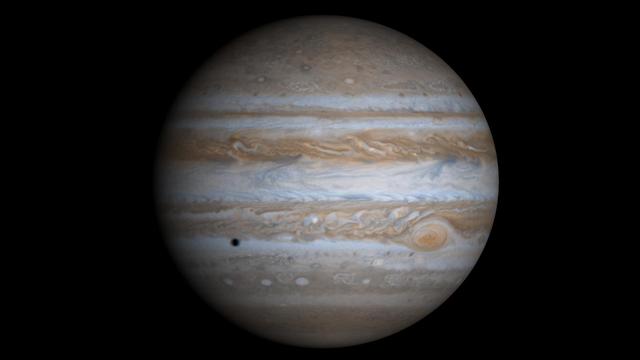
Beneath the colourful bands
Jupiter’s stripes are cloud regions associated with atmospheric currents flowing in different directions. The Great Red Spot is an enormous storm whose shape and size have changed over time. Jupiter is a gas giant: deeper down, pressure and temperature increase, and we would not encounter an Earth-like solid surface on which to land.
A laboratory for gravity
Jupiter’s gravity dominates a system of very different moons. Io is intensely volcanic; Europa has an icy crust beneath which observations support the presence of an ocean. Among other investigations, Juno measures Jupiter’s gravitational and magnetic fields. Small variations in the signals help scientists test models of the planet’s interior, which cannot be observed directly.